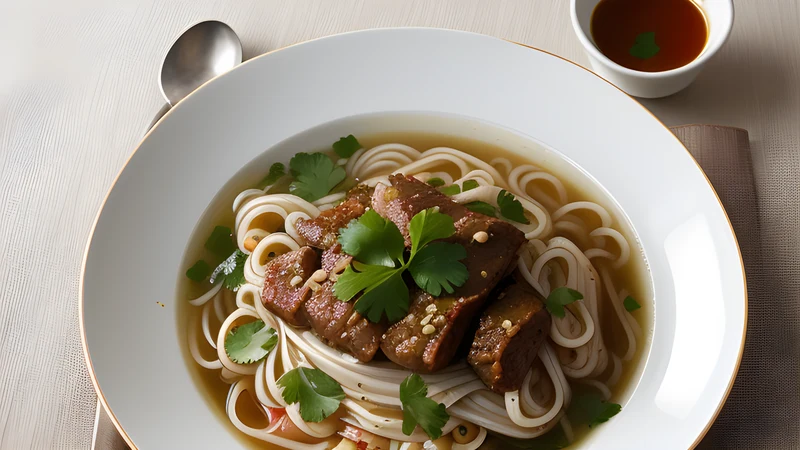
Beshbarmak: The Kazakh Boiled Meat and Noodle Feast
Broad hand-rolled noodles, slow-boiled meat and a broth poured over the top at the table

Contents
↓ Jump to recipeBeshbarmak means five fingers, and the name is a direct instruction rather than a poetic flourish: this is a dish eaten by hand, a broad platter of noodles under sliced boiled meat and softened onions, set in the middle of the table for everyone to reach into together. It is Kazakhstan’s national dish, and one shared closely with Kyrgyzstan, and it carries far more social weight than its short ingredient list suggests. A pot of beshbarmak on the stove usually means guests are expected, or already at the door.
Beshbarmak: The Kazakh Boiled Meat and Noodle Feast
Per serving (1 of 7 servings), estimated from the ingredients. Actual values vary with brands and portions.
The first quantity on each line is scaled. Check amounts mentioned inside a line, and cooking times.
Ingredients
- 1.4kg bone-in lamb shoulder or beef brisket, cut into large pieces
- 3.5 litres cold water
- 2 onions: 1 left whole, halved; 4 more thinly sliced into rings
- 2 carrots, roughly chopped
- 3 bay leaves
- 1 tsp black peppercorns
- 2 tsp fine salt, plus more to taste
- 400g plain flour, plus extra for dusting
- 2 eggs
- 1/2 tsp salt (for the dough)
- About 100ml cold water (for the dough)
- Small bunch dill or flat-leaf parsley, chopped, to finish
- Black pepper, to finish
Method
- Put the meat into a large heavy pot and cover with the 3.5 litres of cold water. Bring slowly to the boil, skimming off any grey foam as it rises.
- Add the halved onion, carrots, bay leaves and peppercorns. Reduce to a bare simmer, part-cover, and cook for 2 to 2.5 hours, until the meat is completely tender and pulling from the bone.
- Lift the meat out onto a board and cover to keep warm. Strain the broth, discard the solids, return the clear broth to the pot, and season with the 2 tsp salt. Keep it warm over low heat.
- While the meat simmers, make the dough: mix the flour and dough salt, beat the eggs into the water, and work into the flour until a firm dough forms. Knead 8 minutes until smooth, then cover and rest 30 minutes.
- Roll the rested dough out thinly, about 2mm, and cut into large diamonds or squares roughly 8cm across.
- Take the sliced onion rings and put them in a heatproof bowl. Ladle over about 200ml of the hot broth, enough to just cover, and leave to soften for 15 minutes; this softens and sweetens the onion without frying it.
- Bring a separate large pan of the broth, or salted water, to a rolling boil and cook the noodle squares in batches for 3 to 4 minutes until tender, lifting them out with a slotted spoon as they finish.
- Slice or pull the cooked meat into large pieces, discarding any bone and excess fat.
- Spread the boiled noodles over a large warmed platter, arrange the meat over the top, and scatter the softened onions and their liquid over everything.
- Ladle a little more hot broth over the platter to keep it moist, finish with chopped dill or parsley and black pepper, and serve the remaining broth in individual bowls alongside.
A dish that runs on hospitality
There is very little seasoning in beshbarmak beyond salt, pepper and the natural savouriness of long-simmered meat, and that restraint is deliberate rather than an oversight. This is a dish built around a nomadic tradition of hospitality, where a guest arriving unannounced, sometimes after days of travel across open steppe, needed to be fed generously and quickly from whatever the household had on hand: meat, flour and water. Elaborate spicing was never really the point. The point was a large, warm, substantial meal that could be put together from a single animal and shared out among however many people showed up, with more broth simply added to stretch the pot if the table grew larger than expected.

Sheep, and historically horse, were animals a nomadic household could not easily preserve once slaughtered, so a large gathering was often the practical occasion for eating one at all: a wedding, a funeral, the arrival of an important guest, or a seasonal celebration gave a household reason to slaughter and then a reason to invite enough people to finish the meat before it spoiled. Beshbarmak grew directly out of that rhythm, a dish sized for the whole animal and the whole gathering rather than portioned for a family of four, and cooking a smaller pot for a quiet weeknight, as the recipe below does, is very much a modern adaptation of something that began as feast food by necessity as much as by choice.
The meat itself carries formal meaning at a traditional table. Particular cuts and, in the most ceremonial versions, the animal’s head are distributed according to who is present, with the most respected guest or eldest person at the table receiving specific pieces as a mark of honour, and the host or a younger family member handling the actual carving and serving. A modern home cook working from lamb shoulder or beef brisket bought at a supermarket sits some distance from that full ceremony, and understanding it explains why beshbarmak has never been a dish eaten alone in a hurry. It assumes company.
Kazakh, Kyrgyz, and the naryn variant
Beshbarmak belongs to both Kazakhstan and Kyrgyzstan, and the two national traditions overlap heavily while keeping a few distinguishing habits. The broad, hand-cut noodle squares described here are the more widely recognised Kazakh style, while some Kyrgyz households favour noodles cut slightly narrower, closer to a wide ribbon than a full diamond, and lean more heavily on horse meat where it is available. A related dish worth knowing by name even if you never cook it is naryn, made from the same broth-and-noodle idea but with the meat, traditionally horse, cut into fine matchsticks and tossed through the noodles rather than laid over the top in slices, giving a completely different mouthful even though the underlying ingredients are close to identical. Neither tradition treats the recipe as fixed; a Kazakh grandmother and a Kyrgyz one would each insist their household’s beshbarmak is the correct one, and both would be right within their own family’s practice.
Two ingredients, and getting both right
Strip away the ceremony and beshbarmak is genuinely just two components done well: a long-simmered meat and broth, and broad, hand-rolled noodles cooked in that same broth. Getting both right matters more than any seasoning choice, because there is so little else on the plate to hide behind.
The meat wants a proper, patient simmer rather than a fast boil. Lamb shoulder or a well-marbled beef brisket, cut into large pieces and started in cold water, gives the broth time to draw out flavour gradually as the pot comes up to temperature, and skimming off the foam that rises in the first 15 minutes keeps the finished broth clear rather than cloudy. From there it is close to two and a half hours of a bare simmer, not a rolling boil, until the meat is fully tender and pulls apart with almost no resistance. Traditional versions often use horse meat, still common and prized in Kazakhstan, but lamb and beef are the accessible substitutes most home cooks outside the region will use, and both give an excellent, rich broth. Lamb also anchors tavë kosi, Albania’s national dish of braised lamb baked under a tangy yoghurt custard.
The noodles are rolled by hand and cut into broad diamonds or squares, noticeably wider than most other Central Asian noodle traditions, closer to a flat pasta sheet cut into large shapes than to anything resembling a thin strand. The dough itself is simple, just flour, egg, salt and water, kneaded until smooth and rested so the gluten relaxes enough to roll thinly without springing back. Roll it out properly thin, around 2mm, since these pieces cook directly in broth rather than a sauce and a dough rolled too thick will still taste raw and doughy at the centre even once the edges are tender.
Why the noodles cook in the broth
Cooking the noodle squares in the meat broth itself, rather than plain salted water, is what ties the two halves of the dish together. The noodles pick up a real depth of savoury flavour as they cook rather than acting as a neutral starch base, and any broth clinging to them when they are lifted out becomes part of the finished platter rather than being poured down the sink. If you are short on broth and need to stretch it, boiling the noodles separately in salted water and dressing them with a generous ladle of the meat broth afterwards is an acceptable shortcut, though the flavour will be a shade less integrated than noodles cooked directly in it.
The onion is doing real work
The pile of sliced onion rings sitting over the meat is doing real work rather than simply decorating the platter. Softening thinly sliced onion in hot broth for 10 to 15 minutes, rather than frying it in oil, mellows its sharpness and brings out a natural sweetness while keeping it tender rather than crisp, and the broth it steeps in comes back to the platter loaded with a light oniony flavour that seasons the noodles underneath as it soaks through them. Do not skip this step or substitute raw onion; the difference between softened and raw onion here changes the whole character of the finished dish, and raw onion piled that generously on top would overwhelm the mild meat and noodles rather than complementing them.
Serving it the traditional way
Beshbarmak is served on one large communal platter set in the middle of the table, not on individual plates, and diners help themselves directly, traditionally by hand, taking pieces of meat, noodle and onion together in each mouthful. The broth is served alongside in small bowls, sipped between mouthfuls of the platter rather than poured entirely over the noodles, keeping the two textures, the moist meat and noodles and the hot clear broth, distinct through the meal rather than turning everything into a single wet dish. If you are serving guests unfamiliar with the eating style, offering forks alongside is entirely reasonable; the flavour is identical either way; only the theatre changes. A small bowl of the softened onion set beside the broth bowls, rather than only piled on the main platter, lets guests add more to their own broth as they go, since preferences for how much onion belongs in a bowl of sorpa vary as much between individuals as between households.
Scaling up for a real gathering
Beshbarmak is fundamentally a feast dish, and if you are cooking it for the kind of gathering it was built for rather than a weeknight family dinner, it scales more easily than most recipes because the ratio between broth and everything else is forgiving. Doubling or tripling the meat and broth quantities works cleanly as long as your pot is large enough to hold everything at a proper simmer rather than a crowded, uneven one, and it is worth cooking the meat in two batches in a smaller pot rather than one overloaded one if your largest stockpot cannot comfortably hold a doubled quantity of meat and still leave room for the liquid to circulate. The noodle dough also scales directly; just roll and cut it in batches so you are not trying to manage an unwieldy sheet of dough across your whole worktop at once. What does not scale as forgivingly is timing: rolling and cutting noodles for a dozen guests takes real time, so budget at least an hour for that stage alone if you are cooking for a full table rather than a quiet family meal.
Getting ahead and storage
The meat and broth can be cooked up to two days ahead and refrigerated separately, which if anything improves the broth once the fat has risen and can be skimmed cleanly off the top before reheating. Reheat the broth to a simmer before returning the meat to warm through, and cook the noodles fresh just before serving; boiled noodle squares that have sat around go gluey and lose the tender bite that makes fresh ones worth the rolling. The uncooked noodle dough itself can be rolled and cut a few hours ahead, dusted generously with flour and left under a tea towel, but is best not left overnight, since it dries out and becomes brittle to work with. Layer the cut squares between sheets of baking paper if you need to stack them for storage, since fresh dough left in direct contact with itself will stick and tear when you try to separate the pieces again.
Beshbarmak sits alongside two other Central Asian centrepieces that share its instinct for feeding a full table from one pot: manti, the cumin-spiced lamb dumplings that turn up at the same family gatherings, and plov, the Uzbek rice dish built to feed forty from a single enormous pot. All three grew out of the same nomadic and settled Central Asian tradition of cooking for whoever is at the table, however many that turns out to be, rather than portioning a meal out in advance.
Read next