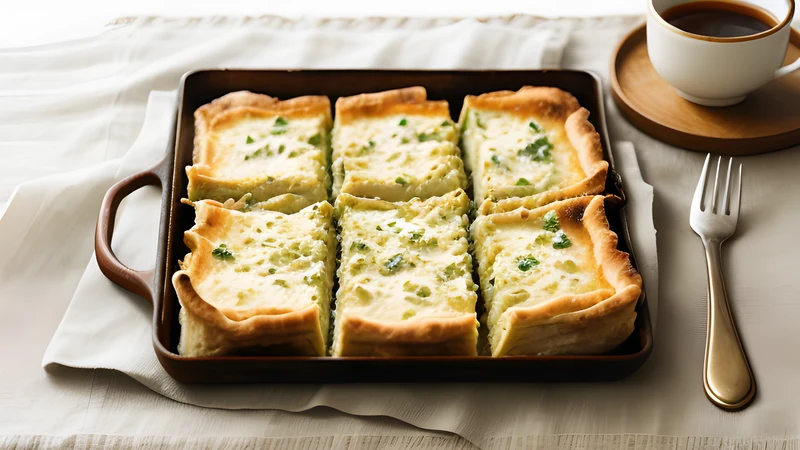
Cheese Börek
The rolled filo pie that turns a spiral into a crisp, crackling loaf

Contents
↓ Jump to recipeBörek covers a whole family of Turkish filo pastries — rolled, layered, fried, baked, filled with cheese, spinach, minced meat or potato — and the version most worth learning first is the spiral. Instead of stacking filo sheets flat into a tray, the way baklava or spanakopita does, this method rolls each buttered, filled sheet into a loose cigar and coils it into a round tin, sheet after sheet, until the whole pie is one continuous spiral you can pull apart wedge by wedge. The shape earns its keep functionally: it gives the finished börek far more crisp surface area per bite than a flat layered version, since every turn of the coil is its own thin, blistered edge rather than being buried under the sheets above it. The twist here is browning the butter before it goes anywhere near the filo, which sounds like a small change and reads as one the moment you taste the difference — nutty and rounded rather than just fatty.
Cheese Börek
Per serving (1 of 7 servings), estimated from the ingredients. Actual values vary with brands and portions.
The first quantity on each line is scaled. Check amounts mentioned inside a line, and cooking times.
Ingredients
- 8 sheets filo pastry (about 270g), thawed if frozen
- 100g unsalted butter
- 250g feta, crumbled
- 200g cottage cheese or curd cheese
- 1 egg, plus 1 extra egg yolk for the wash
- 2 tbsp chopped flat-leaf parsley
- 2 tbsp chopped fresh dill
- 1/4 tsp black pepper
- 3 tbsp milk
- 2 tbsp nigella seeds or sesame seeds, for the top
- 1 tbsp olive oil
Method
- Melt the butter in a small pan over medium heat and continue cooking, swirling often, for 4-5 minutes until it smells nutty and the milk solids at the bottom turn deep golden brown. Remove from the heat immediately and set aside to cool slightly.
- In a bowl, mix the feta, cottage cheese, whole egg, parsley, dill and black pepper until evenly combined. Do not add extra salt — feta is salty enough on its own.
- Preheat the oven to 190C fan (210C conventional) and line a round baking tin, about 24cm, with baking paper.
- Lay one sheet of filo on the counter with a long edge facing you. Brush generously with the brown butter, keeping back about 2 tablespoons for the top of the finished coil.
- Spoon a thin, even line of the cheese filling along the long edge closest to you, about 3cm from the edge, leaving the short ends bare.
- Roll the filo up around the filling into a long, loose cigar, working from the filled edge, then curl the cigar into a loose spiral.
- Repeat with the remaining sheets and filling, coiling each new cigar onto the outside of the spiral already in the tin, so the whole thing builds outward into one large coil filling the tin.
- Whisk the egg yolk with the milk and brush over the entire top of the coil. Scatter over the nigella or sesame seeds and drizzle with the olive oil.
- Bake for 35-40 minutes until deeply golden and audibly crisp when tapped. Rest 10 minutes before cutting into wedges.
Why brown butter, specifically
Filo pastries live or die on the fat brushed between the layers, and plain melted butter, while completely standard, brings nothing to the pastry beyond richness and a browning agent. Cooking the butter until the milk solids toast at the bottom of the pan adds a genuinely nutty, faintly caramelised flavour that melted butter simply doesn’t have, and because filo is so thin and so absorbent, that flavour comes through clearly in every layer rather than getting lost. It’s a five-minute step that changes the pastry more than almost any other single choice in the recipe. Watch it closely once it starts foaming — there’s a narrow window between “brown and nutty” and “burnt and bitter,” usually less than a minute, so pull it off the heat the moment the solids turn the colour of hazelnut skin, not walnut shell.
Handling filo without it turning to confetti
Filo dries out and cracks within minutes of being unwrapped, which is the single biggest reason home cooks avoid it. Keep the stack you’re not currently working with covered with a barely damp tea towel over the unused sheets — actual wet moisture makes filo gummy rather than protecting it. Work quickly once you start: brush, fill, roll, move to the next sheet, rather than prepping several sheets in advance and letting the first ones sit exposed. If a sheet does tear while you’re working with it, don’t panic — a small tear disappears once it’s rolled and coiled, since the structure comes from the whole spiral rather than any single unbroken sheet.

Building the coil
Start the spiral in the centre of the tin with the first rolled cigar, then curl each subsequent one around the outside of what’s already there, keeping the coil reasonably loose rather than packed tight — filo expands slightly as it bakes, and a too-tight coil can crack apart under that pressure rather than holding its shape. The filling line should be thin and even along each sheet; overfilling is the most common way to end up with a soggy, leaking börek, since a thick line of wet cheese filling has nowhere to go but out through the thin pastry as it heats and expands. Aim for a line about as thick as your finger, no more.
The filling ratio
Feta alone, without something to soften it, bakes into a dense, squeaky, overly salty filling. Cutting it with cottage cheese or curd cheese — texturally closer to ricotta — lightens the whole thing and stops the finished börek from tasting one-note salty. The egg binds the mixture so it doesn’t run out during baking, and it’s worth resisting the urge to add extra salt: feta varies in saltiness by brand, but it is almost never under-salted, and a filling that tastes slightly too salty raw will taste correctly seasoned once it’s baked inside pastry that has none of its own.
Where the spiral shape comes from
The coiled sarma-style börek — the name comes from the Turkish verb sarmak, to wrap or roll — is one of several regional shapes the same filo-and-filling idea takes across Turkey and the wider Balkan-Ottoman pastry tradition. Flat, stacked su böreği is boiled briefly before baking, giving it a softer, almost lasagne-like texture; triangular sigara böreği wraps individual portions into small fried cigars, popular as a starter or bar snack; and this coiled version, sometimes called gül böreği (rose börek) for its resemblance to a coiled flower, is the one most associated with home baking and family gatherings, largely because a single large coil feeds a table without any per-portion assembly. Its structure also happens to solve a genuine problem with filo baking: because heat can reach every turn of the spiral from the outside in, it browns and crisps more evenly across its surface than a flat stack does, where the bottom layers can stay pale and slightly soft even after the top has gone deep gold.
Getting the coil into the tin without it collapsing
The trickiest physical moment in the whole process is transferring each filled, rolled cigar into position without the filling squeezing out of the ends or the roll unravelling on the way. Work directly over or right beside the tin rather than rolling on a board and then carrying the cigar across the kitchen — the less distance a loosely rolled filo tube travels, the less chance it has to come apart. Curl each one gently, resting it against the coil already in place rather than forcing it into a tight curve; filo has some give but not much, and pushing it into too sharp a bend is a common way to split the outer layer.
If you’re making this for the first time, it helps to do a dry run with the first sheet before committing filling to it — roll a plain buttered sheet with no filling to get a feel for how tightly you can coil the filo before it resists, so the first real, filled cigar isn’t also your first attempt at the technique.
What can go wrong
A pale top with a soggy underside almost always means the oven wasn’t hot enough or the börek came out too early — 190C fan for the full 35-40 minutes is not excessive for something this size; filo needs sustained heat to drive off all the moisture from the filling and crisp all the way through the multiple wrapped layers. Tap the top gently before pulling it from the oven: it should sound hollow and feel genuinely firm to the touch.
A coil that unravels when you try to cut it usually means it wasn’t rested long enough after baking. The ten-minute rest lets the egg in the filling finish setting and the structure firm up; cut into it straight from the oven and the wedges will collapse rather than hold their shape.
Choosing the cheese
Not all feta is equal for this, and it’s worth spending slightly more on a proper Turkish or Bulgarian sheep’s-milk feta rather than the cheapest cow’s-milk block on the shelf, which tends to be milder, wetter and less distinctly tangy. Sheep’s-milk feta has a firmer crumble and a sharper, more pronounced flavour that stands up better against the nuttiness of the brown butter — a mild feta gets lost in the pastry rather than cutting through it. If cottage cheese isn’t to hand, ricotta works nearly as well, though it’s slightly wetter, so squeeze it briefly through a sieve or muslin cloth before mixing to keep the filling from turning the filo soggy from the inside.
Dried herbs can stand in for fresh dill and parsley in a pinch, but use a third of the quantity and expect a flatter, less lively filling — fresh herbs are doing real work here, both in flavour and in the visible green flecks that tell you, before you even bite in, that there’s more going on than plain cheese.
Variations and storage
Spinach and feta is the most common variation on this filling — wilt and thoroughly squeeze dry 200g of spinach and fold it through in place of half the cottage cheese, making sure to press out as much water as possible, since spinach that’s still wet will thin the filling and work against everything the brown butter and thin filling line are trying to achieve. A scattering of crumbled walnuts through the filling adds welcome texture against the soft cheese, and a minced-lamb version, cooked off first with onion and a pinch of cinnamon until dry rather than juicy, follows the same rolling and coiling method exactly.
Leftover börek keeps for 2 days at room temperature in an airtight container and reheats well in a hot oven for 8-10 minutes to restore the crispness a microwave would ruin — the microwave softens the filo into something closer to wet paper, which defeats the entire point of the dish. It doesn’t freeze well once baked, since filo turns leathery on thawing no matter how carefully it’s wrapped, though the unbaked, assembled coil freezes fine for up to a month, tightly wrapped in cling film and then foil, and can go straight from freezer to oven with an extra 10 minutes added to the bake time and the temperature dropped slightly, to 180C fan, so the centre has time to cook through before the top over-browns.
Serve it warm rather than hot — straight from the oven the filling is molten and the flavours haven’t settled, while ten minutes’ rest lets the cheese firm slightly and the nutty butter come through properly — cut into wedges, alongside a simple glass of tea. A wedge from the outer rings of the coil tends to be crispest, since those layers had the most direct oven exposure, while a wedge closer to the centre carries slightly more of the soft, cheese-forward filling. For more of this filo-and-cheese register, su böreği shows the boiled-then-baked layered method this spiral departs from, and spanakopita is the closest Greek cousin, built on the same brushed-filo logic with a spinach-forward filling.
Read next