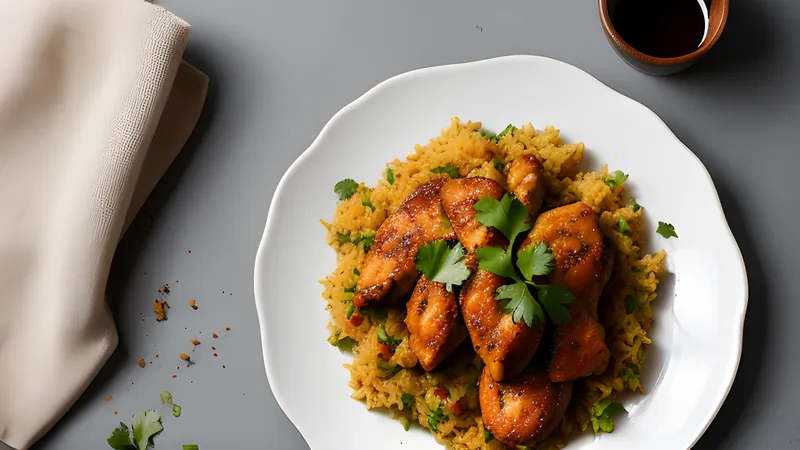
Chicken Korma
A mild curry that earns its richness from browned ghee, not cream alone

Contents
↓ Jump to recipeKorma is one of the most misunderstood dishes on a British curry house menu, usually served as the mild option for people who don’t want heat, sweetened with coconut and reduced to a beige paste with little going on beyond sugar and cream. The dish it’s descended from is neither sweet nor bland. Korma comes from the Mughal courts of northern India, a braising technique (the word itself means something close to “to braise” in Urdu) built on slow-cooked meat, a base of browned onions, whole spices bloomed in fat, and a thickener of nuts or yoghurt rather than sugar. Mild doesn’t have to mean flavourless, and a properly made korma proves it — the richness comes from technique — browned onions, bloomed whole spices, a nut or yoghurt thickener doing the work sugar does in the beige version.
Chicken Korma
Per serving (1 of 4 servings), estimated from the ingredients. Actual values vary with brands and portions.
The first quantity on each line is scaled. Check amounts mentioned inside a line, and cooking times.
Ingredients
- 50g raw cashews
- 200ml warm water, for soaking cashews
- 4 tbsp ghee
- 1 large onion, thinly sliced
- 4 cloves garlic, minced
- 1 tbsp fresh ginger, minced
- 1 cinnamon stick
- 4 green cardamom pods, lightly crushed
- 4 cloves
- 1 bay leaf
- 1 tsp ground coriander
- 1/2 tsp ground turmeric
- 1/2 tsp chilli powder (adjust to taste)
- 800g boneless chicken thigh, cut into 4cm pieces
- 150g plain full-fat yoghurt, whisked smooth
- 150ml chicken stock or water
- 1/2 tsp garam masala
- 1 tsp salt, plus more to taste
- 2 tbsp flaked almonds, toasted, to serve
- Fresh coriander leaves, to serve
Method
- Soak the cashews in 200ml warm water for 20 minutes, then blend to a smooth paste with the soaking water. Set aside.
- Heat the ghee in a heavy pot over medium heat, swirling occasionally, until it turns a deep golden-brown and smells nutty, about 4-5 minutes. Watch closely in the last minute; it goes from brown to burnt quickly.
- Add the onion and cook 12-15 minutes over medium heat, stirring often, until deeply golden and soft.
- Add garlic and ginger, cook 2 minutes until fragrant.
- Add cinnamon, cardamom, cloves and bay leaf, toast 1 minute in the ghee until aromatic.
- Stir in ground coriander, turmeric and chilli powder, cooking 30 seconds to bloom the spices without burning them.
- Add the chicken pieces and stir to coat in the spice mixture, cooking 5 minutes until the outside turns opaque.
- Lower the heat and stir in the whisked yoghurt one spoonful at a time, stirring constantly so it doesn't split.
- Add the cashew paste and stock. Bring to a gentle simmer, cover, and cook 20-25 minutes until the chicken is tender and the sauce has thickened.
- Stir in garam masala and salt, adjusting both to taste. Simmer uncovered 5 minutes if the sauce needs thickening further.
- Serve topped with toasted flaked almonds and fresh coriander leaves.
The twist
The single biggest change that separates a good korma from a bland one is browning the ghee before anything else goes into the pot, rather than melting it and moving straight to the onions. Ghee is already clarified butter with the milk solids removed, but taken a step further and cooked until the remaining solids toast to a deep brown, it develops a nutty, almost toffee-like depth that plain melted ghee doesn’t have. Every subsequent layer of the dish — the onions, the whole spices, the meat itself — cooks in that browned fat and picks up a trace of it, which is what gives a well-made korma its characteristic warmth even without any chilli heat behind it.
Building the base properly
Onions cooked low and slow until deeply golden, not just softened, are doing more structural work in this dish than any single spice. Twelve to fifteen minutes over medium heat, stirred regularly so they colour evenly rather than catching in patches, breaks the onions down enough that they essentially dissolve into the sauce, contributing sweetness and body without needing sugar added separately. Rushing this step with high heat browns the outside of the onion slices before the inside has softened, giving you a sauce with unpleasant bitter, burnt notes running through an otherwise mild dish — patience here matters more than almost anywhere else in the recipe.
Whole spices — cinnamon, cardamom, cloves, bay — go in after the onions and get their own brief toast in the hot ghee before the ground spices follow. This order matters: whole spices need direct contact with hot fat for a minute or so to release their essential oils, while ground spices burn almost instantly at the same temperature and only need thirty seconds before liquid goes in to protect them. Adding everything at once, a common shortcut, under-develops the whole spices and risks scorching the ground ones.
Yoghurt, not cream
A common mistake in home korma recipes is reaching for double cream to get the sauce’s characteristic richness. Traditional korma gets its body from yoghurt and ground nuts — cashews here, though almonds or melon seeds appear in different regional versions — and the distinction matters for both flavour and technique. Yoghurt brings a gentle tang that cuts through the richness of the browned ghee, something cream can’t offer since it has no acidity of its own. It also needs careful handling: added straight from the fridge to a hot pan, or poured in all at once, yoghurt splits into curds and a thin, watery liquid, which no amount of stirring later will fully recombine. Whisk it smooth first, bring it closer to room temperature, and stir it in gradually, a spoonful at a time, letting each addition incorporate before the next goes in and lowering the heat if the pot seems too hot for it to stay stable.
What goes wrong
The most common failure is a split sauce, almost always from yoghurt added too fast or over heat that’s too high. If it does split, a stick blender briefly run through the sauce can bring it back together into something acceptable, though the texture won’t be quite as silky as one that never split in the first place. The second failure is under-browning the onions and compensating with more sugar or cream to fake the richness — there’s no real substitute for the twelve to fifteen minutes the onions need, and shortcuts here are the most common reason home versions taste flat compared with a well-made restaurant korma. The third is over-toasting the ghee past golden-brown into actually burnt, which happens fast in the last minute of browning and turns the whole dish bitter; pull it from the heat the moment it smells nutty rather than waiting for a specific colour, since colour alone is hard to judge accurately in a dark pot.
Serving
Korma is rich enough that it doesn’t need much beside it beyond something to carry the sauce. Plain basmati rice, cooked so the grains stay separate rather than clumping, is the standard pairing and lets the sauce be the focus rather than competing with a heavily seasoned side. Naan or roti work equally well for scooping, and either is a better match than a strongly spiced pilau, which would layer its own flavours over a dish that’s already carrying whole spices, browned onion and toasted nuts. A squeeze of lemon at the table, rather than cooked into the sauce, gives diners the option to brighten the dish further without changing the base recipe for everyone.
Variations
Lamb shoulder, cut into chunks and given an extra 20-30 minutes of simmering time to tenderise, makes a heartier version closer to what you’d find at a wedding feast in northern India. A vegetable korma built the same way, with cauliflower, potato and peas replacing the chicken, works well for a meat-free version and needs less simmering time since none of the vegetables need tenderising the way chicken thigh does. For a version leaning further into the dish’s Mughal roots, a few strands of saffron bloomed in a tablespoon of warm milk and stirred in at the end adds colour and a floral note that plays well against the browned ghee’s nuttiness. Serve alongside cucumber raita for a cooling contrast, and aloo gobi makes a good vegetable side if you want a fuller spread on the table.
The British curry house version and why it drifted
It’s worth understanding how far the curry house korma drifted from its origins, because knowing the gap helps explain what this recipe is trying to recover. Post-war British curry houses, largely run by Bangladeshi restaurateurs cooking to a British palate that wanted recognisable categories of heat, settled on korma as the designated “mild” option on a spice scale running from korma through to phall. To hit that mild mark reliably across a busy kitchen, many restaurants leaned on coconut milk, sugar and cream as shortcuts to richness, since browning onions properly for fifteen minutes per order isn’t practical during a Friday night service. Over decades that shortcut became the default recipe most people in Britain associate with the word korma, to the point that a properly made Mughal-style version, mild but built on real technique rather than sweetness, can taste unfamiliar to someone who’s only had the takeaway version. Neither is wrong exactly, but they’re different dishes wearing the same name, and this recipe follows the older, technique-driven one.
Cashews versus other thickeners
Cashews are the most common nut base for korma in contemporary Indian cooking, prized because they blend to an especially smooth, neutral-tasting paste that thickens the sauce without adding a strong nut flavour of its own. Almonds, blanched to remove their skins first, are a traditional alternative with a slightly more assertive flavour that comes through a bit more in the finished dish. Melon seeds (magaz) appear in some older Mughlai recipes and are harder to find outside South Asian grocers, but worth trying if you come across them, since they thicken without any nuttiness at all, letting the spices and browned onion carry the flavour entirely. Whichever you use, soak first in warm water to soften them before blending; skipping the soak leaves a gritty texture in the finished sauce that no amount of blending time fully resolves.

Getting the chicken right
Thigh meat, not breast, is the better choice for korma and most slow-simmered curries generally — its higher fat content keeps it tender through the twenty-plus minutes of gentle simmering the sauce needs to come together, while breast meat tends to dry out and turn stringy over the same cooking time. Cut the pieces a consistent size, around 4cm, so they cook evenly; pieces that vary widely in size mean some are overdone by the time the largest ones are properly cooked through. If you do want to use breast meat, add it later, in the final ten minutes of simmering, rather than at the start with the spices, to avoid the same overcooking problem.
Storage
Chicken korma keeps in the fridge for up to three days and, like most slow-cooked curries, actually improves overnight as the spices continue to infuse through the sauce. Reheat gently over low heat, stirring often and adding a splash of water or stock if the sauce has thickened too much in the fridge — the yoghurt-based sauce is more prone to catching and scorching on direct high heat than a tomato-based curry, so keep the heat moderate throughout. It also freezes well for up to two months; thaw fully in the fridge overnight before reheating rather than trying to defrost it directly in the pan.
Read next