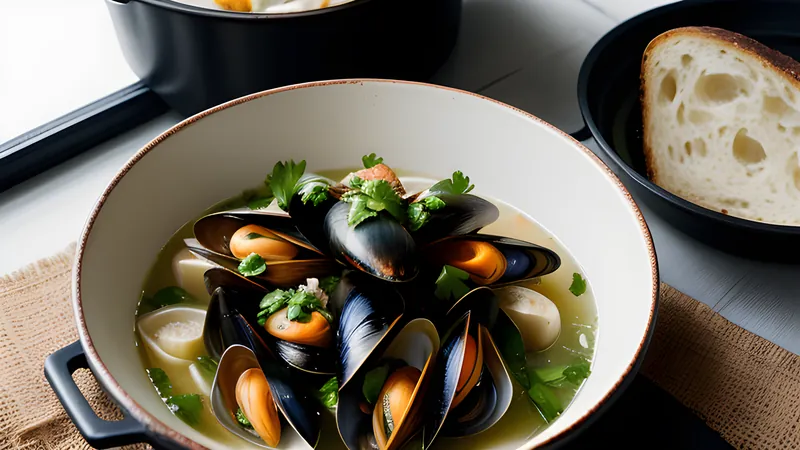
Comorian Langouste a la Vanille: Lobster in Vanilla Cream
French technique meets an Indian Ocean spice crop, in a sauce built to actually taste of vanilla

Contents
↓ Jump to recipeLangouste a la vanille is the dish that best explains what happened when French culinary technique settled permanently in the Comoro Islands, one of the world’s great vanilla-growing regions of the Indian Ocean. It takes the classic French reflex of building a rich sauce from shallot, wine and cream, and points that entire technique at a spice most cooks only ever meet in a dessert, using it instead to season a delicate, prized local shellfish. The result is a sauce that tastes unmistakably of vanilla, warm, floral, faintly smoky, without ever tasting sweet, which is the exact balance the dish depends on and the one most home cooks get wrong on a first attempt by treating vanilla as a pudding ingredient rather than a genuine savoury spice.
Comorian Langouste a la Vanille: Lobster in Vanilla Cream
Per serving (1 of 4 servings), estimated from the ingredients. Actual values vary with brands and portions.
The first quantity on each line is scaled. Check amounts mentioned inside a line, and cooking times.
Ingredients
- 4 spiny lobster tails, about 200g each, or 2 whole spiny lobsters
- 2 tbsp unsalted butter
- 1 shallot, finely chopped
- 2 garlic cloves, minced
- 1 plump vanilla pod, split lengthways, seeds scraped and reserved separately, pod kept
- 200ml dry white wine
- 300ml double cream
- 1 tbsp lime juice, plus more to taste
- 1/2 tsp fine salt, plus more to taste
- White pepper, to taste
- Small bunch chives, finely snipped, to finish
- Steamed rice, to serve
Method
- Bring a large pot of well-salted water to the boil. Add the lobster tails and cook for 5 to 6 minutes, until just cooked through and opaque. Lift out, cool slightly, then remove the meat from the shells and slice into thick medallions. Set aside.
- Melt the butter in a wide, heavy pan over medium heat. Add the shallot and garlic and cook gently for 4 minutes, until soft but not coloured.
- Add the reserved vanilla pod and half the scraped seeds. Pour in the white wine, raise the heat, and let it bubble hard for 3 to 4 minutes until reduced by about two-thirds.
- Pour in the cream and bring to a gentle simmer. Cook for 8 to 10 minutes, stirring occasionally, until the sauce has thickened enough to coat the back of a spoon.
- Remove the vanilla pod. Stir in the remaining vanilla seeds, the lime juice, salt and a good grind of white pepper. Taste and adjust; the sauce should taste distinctly of vanilla, warm and fragrant rather than sweet.
- Lower the heat as far as it will go and add the lobster medallions to the sauce, turning gently to coat. Warm through for 2 to 3 minutes only, just enough to heat the lobster without cooking it further.
- Spoon the lobster and sauce over steamed rice, scatter with chives, and serve immediately.
An island economy built on a single vine
The Comoros, along with neighbouring Madagascar and the French territory of Mayotte, sits in one of the handful of regions on earth where vanilla is grown commercially, a labour-intensive crop that has to be hand-pollinated flower by flower, since the vanilla orchid’s natural pollinator exists only in its native Mexico. Every pod that reaches a Comorian kitchen has already passed through months of curing, sweating and drying after hand-pollination and harvest, a process that concentrates its aromatic compounds and is largely why good vanilla carries a price closer to a fine spice than a supermarket flavouring. Vanilla, along with cloves and ylang-ylang, has shaped the islands’ agricultural economy for well over a century, arriving alongside French colonial rule and remaining central to Comorian trade long after that rule ended.
Langouste a la vanille grew directly out of that economy: a home-grown, genuinely prized spice, cooked by people whose French-influenced culinary training reached instinctively for cream and butter as a way to carry it, applied to the spiny lobster that thrives in the reef waters surrounding the islands. It is closer to a twentieth-century fusion, invented at the exact point where French technique, colonial trade and local ingredients overlapped, than an old peasant dish stretching back centuries, and it has become one of the dishes Comorian and Mahoran cooking is best known for internationally.
Spiny lobster is the point
The langouste in the dish’s name refers specifically to spiny lobster, sometimes called rock lobster, the clawless variety found across the Indian Ocean and the Mediterranean, distinct from the clawed lobster more familiar in Northern European and North American kitchens. Spiny lobster carries all of its meat in the tail rather than in large claws, with a firmer, slightly denser texture and a flavour most cooks describe as a touch sweeter and less briny than clawed lobster. If you are working outside a region where spiny lobster is easily available, clawed lobster tails are a perfectly reasonable substitute and will not meaningfully change the technique below, though the texture will be a little more tender and the flavour a shade more classically “lobster” than the original dish’s specific character.
Cook the tails briefly in well-salted boiling water rather than the sauce itself; lobster meat toughens fast once it passes the point of just-cooked, and poaching it separately, then warming it gently in the finished sauce for only a couple of minutes at the very end, is the only reliable way to keep it tender. Adding raw lobster meat directly to a simmering cream sauce and leaving it there while the sauce reduces is the single most common way to ruin this dish, turning what should be a plump, yielding bite into something closer to rubber.
Cooking a whole lobster instead of tails
If you can source whole spiny lobsters rather than pre-cut tails, the dish gains a good deal of ceremony, and the method adjusts only slightly. Boil the whole lobsters for 8 to 10 minutes depending on size, rather than the 5 to 6 minutes given for tails alone, then let them cool just enough to handle before splitting them lengthways and removing the tail and any leg meat, discarding the head and shell or reserving them for a separate stock another day. Whole spiny lobster also carries some roe and softer body meat that tail portions alone do not, both of which are considered a delicacy locally and can be folded into the finished sauce in the final warming stage alongside the sliced tail meat, adding a slightly different, richer texture to parts of the dish. Buying whole lobster is more work and, in most markets, meaningfully more expensive than buying tails alone, but it is the closer approximation of how the dish is actually served on the islands, where a whole animal, split and dressed at the table, is as much a part of the occasion as the sauce itself.
Making vanilla taste savoury
The technique that separates a good vanilla cream sauce from a bad one is almost entirely about restraint and where the vanilla enters the process. Split the pod and scrape out the seeds, but keep the empty pod itself and add it to the pan along with the wine during the reduction stage; the pod continues to release aromatic oils as the wine reduces and the cream cooks, building a rounded, background vanilla note into the sauce’s structure rather than a sharp, single-note hit. Hold back roughly half the scraped seeds until right at the end, stirring them in only once the sauce has finished reducing and thickening, off the highest heat. Vanilla’s more delicate aromatic compounds break down with prolonged heat, so adding some of the seeds late preserves a brighter, fresher vanilla character on top of the deeper, cooked-in note the pod contributed earlier.
Salt and a little acidity, here from lime juice, are what keep the finished sauce reading as savoury rather than dessert-adjacent, and both matter more in this dish than in almost any other cream sauce, since vanilla’s natural association with sugar means a home cook’s instinct is often to under-salt for fear of the combination feeling wrong. It does not; a properly salted, lime-brightened vanilla cream sauce reads as a genuinely savoury, restaurant-quality sauce, and skimping on salt because the vanilla feels like a dessert ingredient is the surest way to end up with something that tastes unfinished rather than balanced.
Sourcing good vanilla for a dish that depends on it
This is a recipe where the quality of a single ingredient matters more than almost anywhere else in this list of world dishes, because there is nowhere for a poor vanilla pod to hide. Buy plump, slightly oily, dark pods rather than the driest, cheapest ones you can find; a good pod should bend without snapping and should smell distinctly aromatic through its skin before you even split it. Madagascan or Comorian vanilla, where you can find it specifically labelled, is the most historically apt choice for this dish, though any high-quality Bourbon-type vanilla pod will give a good result. The dish depends on both the seeds’ texture, visible as tiny black flecks through the finished sauce, and the pod’s slow aromatic release during cooking, neither of which a bottle of extract can replicate.

A dish for a genuine occasion
Both langouste and good vanilla are expensive ingredients almost everywhere outside the specific coastal and agricultural regions that produce them, and on the Comoros itself this remains a dish reserved for celebrations, family gatherings and the kind of meal a household plans around rather than something cooked casually on a Tuesday. That context is worth keeping in mind when you cook it at home too. Both ingredients carry the whole dish here, so a tired vanilla pod that has sat in the back of a cupboard for two years, or the smallest, cheapest lobster tails you can find, shows immediately in the finished plate in a way that a heartier, more forgiving stew would disguise. Treat it as an occasion dish rather than a weeknight one, and it rewards that treatment generously.
Variations worth trying
Some coastal households fold a splash of coconut milk into the cream, or replace a portion of the cream with it outright, nodding toward the wider Indian Ocean pantry and giving the sauce a slightly lighter, more tropical character alongside the vanilla. A little fresh ginger, grated finely and sweated with the shallot at the start, is another common addition, adding a gentle warmth that plays well against the cream without competing with the vanilla for attention. If you want a version with a touch more heat, a single finely sliced bird’s eye chilli added with the shallot and garlic is authentic to some coastal preparations, though it should stay firmly in the background; this is a dish built around the vanilla’s aroma first, with everything else in a supporting role.
Serving and getting the timing right
Langouste a la vanille is a dish best cooked to order rather than prepared ahead, since the lobster’s brief final warming in the sauce is timed to the minute and does not benefit from resting or reheating. The sauce itself can be made up to the point of removing the vanilla pod a couple of hours ahead and gently reheated, but add the lobster only once you are ready to serve, and serve it immediately once the meat has warmed through. Steamed white rice is the traditional accompaniment, simple enough to let the sauce be the focus of the plate rather than competing with it.
Langouste a la vanille sits at one end of a wide spectrum of Indian Ocean and African coastal seafood cookery, most of which leans on coconut, chilli and tomato rather than cream and vanilla. Jamaica’s rundown, a coconut fish stew shares the same instinct for a rich, enveloping sauce built to carry delicate seafood, using coconut milk in place of dairy cream, while Tuscany’s cacciucco, the five-fish stew of the coast shows an entirely different European coastal tradition building its own rich base from tomato, wine and a full catch of the day rather than a single prized ingredient. Comparing them says a great deal about how differently coastal communities have chosen to dress the same basic instinct: good, fresh shellfish deserves a sauce built specifically around it, whether that sauce leans on tomato and a full catch of fish, coconut milk and island spice, or, on the Comoros, a spice crop the islands themselves helped put on the world’s tables.
Read next