Red Velvet with Cream Cheese Frosting
The buttermilk classic, with a little miso in the frosting
Contents
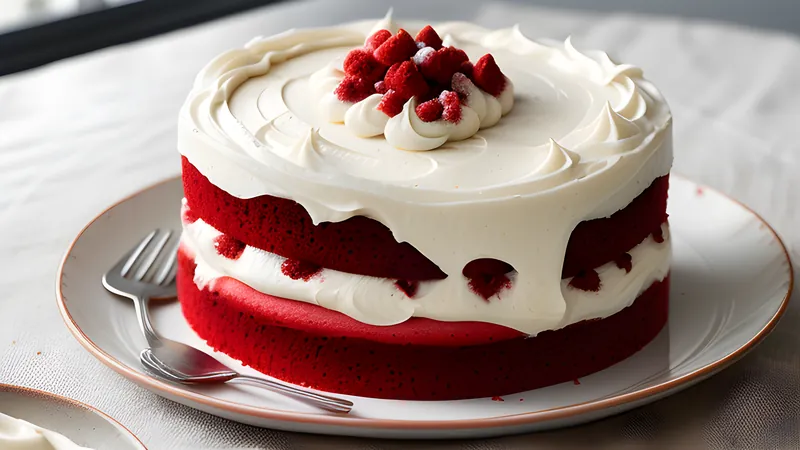
↓ Jump to recipeRed velvet is a cake that trades heavily on drama. Slice into that deep scarlet crumb and set it against a snowdrift of white cream cheese frosting and you have one of the most photographed cakes in the world, a fixture of American bakery windows and wedding tables. But strip away the food colouring and you find something older and quieter: a soft, faintly chocolatey buttermilk cake with a tender, velvety texture that earned it the name long before anyone thought to dye it postbox red.
What red velvet actually is
The “velvet” in the name is the older half of the story. In the late nineteenth century, American bakers used “velvet” to describe cakes made especially soft and fine-crumbed, usually by including cocoa or cornflour to soften the flour’s protein. Red velvet grew out of that tradition as a buttermilk-and-cocoa cake, and its original reddish tint was a happy accident of chemistry: the anthocyanin pigments in natural, non-alkalised cocoa turn a rusty red when they meet the acidity of buttermilk and vinegar, the same reaction that gives devil’s food cake its mahogany colour. The two cakes are close relatives, separated mainly by how much cocoa goes in and how far each leans on that red-brown reaction.
The blazing red we know today came later, and there are two competing origin stories. One credits a 1940s Canadian bakery or the Waldorf Astoria hotel; the more reliable thread runs through the Adams Extract company, whose red velvet recipe dates to the Second World War and helped sell its red food colouring. Modern cocoa is mostly Dutch-processed and alkalised, which kills the natural red reaction entirely, so the colouring is now doing all the work the chemistry once did. This recipe keeps a spoonful of cocoa in for flavour, uses gel colouring for the drama, and puts its one twist into the frosting instead.
Other threads of the story are easier to document. Red velvet layer cake was a famous dessert at New York’s Waldorf-Astoria hotel in the 1920s, and the hotel still claims to have created it. In Canada the cake was a staple of the 1940s and 1950s, served in the restaurants of Eaton’s department store in Toronto and widely attributed as a favourite of Flora Eaton, so Eaton’s and the Waldorf-Astoria both lay claim to the recipe. Food writer Stella Parks traces the underlying idea to the early twentieth century, when recipes for mahogany cake and devil’s food cake were merged into a velvet cocoa cake. Beetroot played its part in the lean decades: during the First World War and the Great Depression, bakers used it to colour and moisten cakes when sugar and fat were short, so a beetroot cake came out red and a chocolate one burgundy.

The cake’s long second act
Red velvet fell out of fashion in the 1970s, after Red Dye No. 2 was linked to cancer concerns and the colouring that gave the cake its name became something bakers avoided. Its revival owes a good deal to cinema. In Steel Magnolias (1989) the groom’s cake is an armadillo-shaped red velvet creation, a Southern set piece that helped renew interest in the cake. Since then the cake has settled into a second life far beyond the American South, turning up in cupcakes, ice cream, lattes and wedding tiers on both sides of the Atlantic. The same drama that made it a Waldorf-Astoria showpiece in the 1920s still does the selling: the scarlet crumb is the filling and the advertisement at once.
Red Velvet with Cream Cheese Frosting
Per serving (1 slice (1 of 12)), estimated from the ingredients. Actual values vary with brands and portions.
The first quantity on each line is scaled. Check amounts mentioned inside a line, and cooking times.
Ingredients
- 250g plain flour
- 1 tbsp cocoa powder
- 0.5 tsp fine salt
- 125g unsalted butter, softened
- 300g caster sugar
- 2 large eggs
- 1 tsp vanilla extract
- 1 to 2 tbsp red food colouring gel
- 240ml buttermilk
- 1 tsp white wine vinegar
- 1 tsp bicarbonate of soda
- For the frosting: 100g unsalted butter, softened
- 300g full-fat cream cheese, cold
- 1 tbsp white miso paste
- 300g icing sugar, sifted
- 1 tsp vanilla extract
Method
- Heat the oven to 160C fan. Butter and line two 20cm sandwich tins.
- Whisk the flour, cocoa and salt together in a bowl.
- Beat the butter and sugar until pale and fluffy, about 4 minutes, then beat in the eggs one at a time, followed by the vanilla and food colouring.
- Add the flour in three goes, alternating with the buttermilk, beginning and ending with flour.
- In a small cup, stir the vinegar into the bicarbonate of soda so it fizzes, then fold it quickly through the batter.
- Divide between the tins and bake for 26 to 30 minutes, until a skewer comes out clean. Cool 10 minutes in the tin, then turn out.
- For the frosting, beat the softened butter with the miso until smooth, then beat in the cold cream cheese just until combined.
- Sift in the icing sugar, add the vanilla and beat briefly until thick and smooth; do not overbeat.
- Sandwich and coat the cooled cakes, then chill for 20 minutes to set before slicing.
The vinegar-and-buttermilk trick
The pairing of buttermilk, vinegar and bicarbonate of soda is doing more than nodding to tradition. Both the buttermilk and the vinegar are acidic, and when the alkaline bicarbonate meets them it releases carbon dioxide, which lifts the cake. Stirring the vinegar directly into the bicarbonate just before folding it in gives you a burst of that gas at exactly the moment the batter goes into the tin, which is why red velvet has such a light, open, tender crumb. The acidity also keeps the sponge soft by limiting gluten development, and it very slightly sharpens the flavour, which stops all that sugar from cloying. Because the reaction begins the instant the acid and alkali meet, get the tins into the oven promptly once it is folded in.
Why miso belongs in the frosting
Cream cheese frosting is the whole point of red velvet, the tangy, cool counterweight to the sweet cake, and it is very hard to improve. The small change here is a spoonful of white miso, beaten smooth into the butter before the cream cheese goes in. Miso is fermented soybean paste, salty and deeply savoury, packed with the same glutamates that make parmesan and soy sauce taste of more. A single tablespoon in a batch of frosting reads simply as a rounder, more complex saltiness that makes the tang of the cream cheese sing and keeps the sweetness in check. Think of it as a more interesting version of the pinch of salt every good frosting already needs.
The method matters as much as the ingredients. Cream cheese frosting fails when it is overbeaten: the emulsion breaks and the whole thing slumps into a sad puddle. Beat the butter and miso until smooth first, add the cold cream cheese and mix only until combined, then add the icing sugar and beat just to a spreadable thickness. Use full-fat block cream cheese, never the low-fat tubs, which carry too much water to hold a shape.
Getting the colour right
The blazing red is the one thing people fret over, and gel colouring is the answer. Liquid supermarket colouring is weak and watery, so you end up pouring in so much to reach a true red that you slacken the batter and can leave a faintly bitter, dye-heavy taste. Concentrated gel or paste colouring, sold in little pots in the baking aisle, gives a deep, even red from a spoonful or two without upsetting the batter. Add it with the eggs so it disperses evenly, and judge the shade in the raw batter knowing it darkens a touch as it bakes. If you would rather avoid colouring altogether, lean into the cocoa for a natural russet cake and simply call it what it once was.
Storage and making ahead
Both sponges can be baked a day in advance and kept well wrapped at room temperature. The frosting can be made a day ahead too, kept in the fridge and beaten briefly to loosen before use. Once assembled, the cake keeps for up to four days in the fridge because of the dairy in the frosting, though it is best eaten within two or three; always bring slices back to room temperature so the crumb softens and the flavour opens up. The unfrosted sponges freeze well for up to three months.
Variations
For a gentler colour, halve the food colouring and lean on the cocoa for a natural rusty tone, which some people prefer to the fire-engine version. Fold in the zest of an orange for a citrus lift, or add a teaspoon of instant espresso to the batter to deepen the cocoa, a trick borrowed straight from coffee and walnut cake. For a striking finish, press the reserved cake trimmings into fine crumbs and scatter them up the sides of the frosted cake, the classic bakery flourish that shows off the colour and gives every slice a soft, ruby edge.
Read next