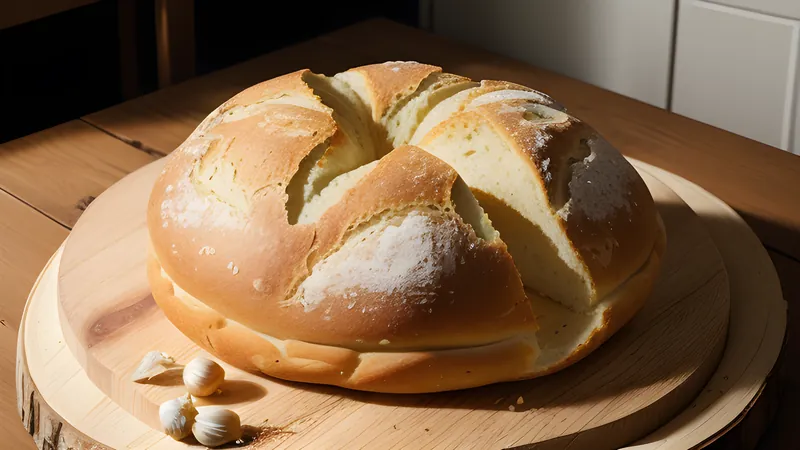
No-Knead Overnight Sourdough Loaf with Roasted Garlic and Rosemary
A slow loaf, sweet with caramelised garlic
Contents
↓ Jump to recipeThere is a particular smugness in pulling a sourdough loaf out of the oven, and the loaf justifies it. This one earns the swagger honestly: a slow overnight ferment does almost all the work for you, and the result is a blistered crust, an open, chewy crumb, and tucked all the way through it the sweet, mellow hum of roasted garlic and the resinous note of rosemary. On the day you bake it, the kitchen smells like the best decision you have made all week.
The sourdough is gloriously traditional. The clever twist is the garlic. Raw garlic folded into a dough would be aggressive and uneven, sharp pockets of it ambushing you slice by slice. Roasting a whole head first changes it completely: the cloves turn soft, jammy and almost sweet as their harsh allicin breaks down under heat and the sugars caramelise. Mashed to a paste and worked through the dough, it perfumes the whole loaf. You taste garlic in every bite, gently, like a rumour.
No-Knead Overnight Sourdough Loaf with Roasted Garlic and Rosemary
Per serving (1 slice (1 of 12)), estimated from the ingredients. Actual values vary with brands and portions.
The first quantity on each line is scaled. Check amounts mentioned inside a line, and cooking times.
Ingredients
- 1 whole head of garlic
- 1 tbsp olive oil, plus extra for the garlic
- 100g active sourdough starter (bubbly, recently fed)
- 375g strong white bread flour
- 75g wholemeal or spelt flour
- 320ml water, lukewarm (about 28C)
- 9g fine sea salt
- 2 tbsp finely chopped fresh rosemary
- Fine semolina or rice flour, for dusting
Method
- Slice the top off the garlic head, sit it on foil, drizzle with oil, wrap and roast at 190C for 40 minutes until soft and golden. Cool, then squeeze out the cloves and mash to a paste.
- Whisk 100g starter into 320ml lukewarm water until cloudy. Add 375g bread flour and 75g wholemeal flour and mix to a shaggy dough with no dry patches. Cover and rest for 45 minutes.
- Add 9g salt, the roasted garlic paste and 2 tbsp chopped rosemary. Squeeze and fold the dough in the bowl until everything is evenly distributed.
- Over the next 2 to 3 hours, give the dough four sets of stretch-and-folds, spaced about 40 minutes apart, until it is smooth and holds its shape.
- Cover and leave to rise at room temperature until roughly 50 per cent bigger and visibly puffy, 4 to 6 hours depending on warmth.
- Tip out, shape into a tight round, and settle seam-side up in a well-floured banneton or cloth-lined bowl. Cover and refrigerate overnight, 12 to 16 hours.
- Next day, put a lidded cast-iron pot in the oven and heat to 240C. Turn the cold loaf out onto baking paper and score the top deeply.
- Lower the loaf into the hot pot, cover, and bake for 25 minutes. Remove the lid and bake for a further 20 to 25 minutes until deep brown and hollow-sounding.
- Cool completely on a wire rack before slicing, at least an hour, so the crumb sets.
Why no-knead works
No-knead bread sounds like a shortcut, and in effort it is, but it is not a compromise on quality. What kneading does is develop the gluten network that gives bread its structure. Time does exactly the same thing, more slowly. Leave a wet dough to sit and the flour hydrates fully, the gluten strands align on their own, and a few gentle stretch-and-folds along the way build all the strength you need without any wrestling. The technique was popularised by baker Jim Lahey and the New York Times’ Mark Bittman in 2006, and it turned home bread-making on its head.
For scale, the formula against the 450g of flour in the recipe (the flour and water inside the starter are not counted):
| Ingredient | Grams | Baker’s percentage |
|---|---|---|
| Flour (375g white, 75g wholemeal or spelt) | 450 | 100% |
| Water | 320 | 71% |
| Sourdough starter | 100 | 22% |
| Fine sea salt | 9 | 2% |
| Chopped rosemary | 2 tbsp | n/a |

The other half of the magic is the long, cold ferment in the fridge. That overnight rest is where flavour develops. The wild yeast and lactic acid bacteria in your starter keep working slowly in the cold, producing the acids and aromatic compounds that give sourdough its tang and complexity. Bake the dough straight away and you get bread; let it sit overnight and you get sourdough, with all the character the word implies. The cold also firms the dough, which makes it far easier to score and turn out.
The two bacteria at work are worth knowing about, because they explain the flavour. Lactobacillus produces lactic acid, mild and yoghurty, while acetic acid, sharper and more vinegary, builds up in cooler, stiffer conditions. A long cold retard pushes the balance towards that brighter, more complex tang, which is why fridge-fermented loaves taste noticeably more interesting than dough rushed at room temperature. Wholemeal or spelt flour in the mix feeds those microbes with extra minerals and enzymes, so the small proportion here is not only about flavour and colour; it gives the ferment more to work with and lifts the whole loaf.
Reading the dough
This is the part that intimidates people, and it is easier than it sounds. Sourdough timings in a recipe are always approximate, because they depend on your starter, your flour and the temperature of your kitchen. A warm summer afternoon moves things along fast; a cold March evening slows everything to a crawl.
So watch the dough, not the clock. During the bulk rise you are looking for it to grow by about half, to feel puffy and alive, and to wobble when you nudge the bowl. A few bubbles on the surface are a good sign. If your kitchen is cold and it is taking forever, do not panic. Patience is rewarded here, and an under-proved loaf is far better than an over-proved one that has spread and collapsed. The poke test helps: press a floured finger into the dough, and if the dent springs back slowly and partway, it is ready.
The bake
A preheated cast-iron pot with a lid is the single best tool for home sourdough, and it is hard to argue with. As the loaf bakes inside it, the dough releases steam that gets trapped under the lid, keeping the crust soft and flexible just long enough for the bread to spring up dramatically. Take the lid off halfway and the trapped moisture escapes, the surface dries, and that deep-brown, crackly crust forms. Without steam you get a pale, tight loaf; with it you get oven spring and shatter.
Scoring matters too. That deep slash across the top is not decoration, though it is handsome. It gives the loaf a deliberate place to expand, so it opens cleanly along your cut rather than bursting at a weak point on the side. Be braver with the blade than feels natural; a timid score barely opens at all. Score at a shallow angle to encourage an “ear”, the raised lip of crust that lifts as the loaf springs.
Tips, substitutions and storage
Roast the garlic the day before if it suits your schedule. It keeps happily in the fridge for a few days, and a head of roasted garlic is a useful thing to have around regardless. If you do not keep a starter, this dough adapts well to a poolish made with a pinch of commercial yeast and an overnight rest; you lose some of the tang but keep the open crumb and the convenience.
Swap the rosemary for thyme, or fold in a fistful of grated mature cheddar at the same stage, and you have a different loaf entirely. Add the rosemary judiciously: it is a strong, piny herb, and a heavy hand turns the loaf medicinal. Two tablespoons of finely chopped fresh rosemary through 450g of flour is plenty; chop it fine so it distributes evenly rather than leaving woody spikes. Dried rosemary works at half the quantity but crumble it well, since whole dried needles stay hard and unpleasant even after baking.
A note on the roasted garlic: roast it until it is genuinely soft and golden, squeezable like paste, not merely warmed through. Under-roasted garlic keeps too much of its raw bite and will still assert itself unevenly in the crumb. If the top of the head browns before the cloves are soft, cover it with a little more foil and give it another ten minutes. The cloves should slide out of their skins when you squeeze the base of the head.
The bread is glorious fresh, but it makes the finest toast imaginable on day two, the garlic deepening overnight. Store it cut-side down on a board for a day, then in a paper bag or a bread bin; it keeps well for three days and freezes cut into slices for toasting straight from frozen. Do not keep it in the fridge, which stales bread faster than the counter by encouraging the starch to recrystallise.
This loaf is wasted on a sandwich. Eat it on its own, slathered with cold butter, and let it be the point. That said, it makes glorious toast under smashed avocado with dukkah, feta and chilli flakes, and it makes a good base for eggs Benedict on sourdough muffins for a proper weekend breakfast.
Read next