National Tiramisu Day

Most of Italy’s most famous desserts trace back centuries, their origins lost somewhere in regional convent kitchens or medieval trade routes. Tiramisu is the exception: its invention is generally dated to the 1960s or early 1970s at Le Beccherie, a restaurant in Treviso in Italy’s Veneto region, making it young enough that people who plausibly tasted the very first version are still alive today.
Origin
Le Beccherie’s claim rests on the account of Roberto “Loly” Linguanotto, a pastry chef at the restaurant, who has described developing the recipe alongside restaurant owner Ada Campeol in the restaurant’s kitchen. The dessert’s name — tiramisù, Italian for “pick me up” or “cheer me up” — is usually explained as a reference to the jolt of the espresso and, in some versions, a splash of Marsala wine folded into the layers, a combination understood from the start as a restorative rather than a purely decorative dessert. Le Beccherie added tiramisu to its menu in the early 1970s, and the restaurant has continued to display its claim to the dessert’s invention as a point of local and national pride, though it has fielded competing claims from other Veneto establishments over the decades.

Food historians treat the exact attribution as more contested than restaurant marketing suggests: several other restaurants and home cooks in the Veneto and neighbouring Friuli region have claimed independent or earlier versions of a similar mascarpone-and-coffee dessert dating to the same postwar decades, and some historians point to older regional puddings involving savoiardi biscuits soaked in coffee or wine as clear structural ancestors. What is not seriously disputed is the region: virtually every credible origin account places tiramisu’s development somewhere in the Veneto in the decades following the Second World War, a period when mascarpone — a fresh, high-fat cheese traditionally produced in nearby Lombardy — had become widely available to restaurant kitchens across northern Italy. Trade publications and Italian regional food associations have, at various points since the 1980s, attempted to mediate the Veneto’s competing origin claims, generally concluding that while Le Beccherie’s public account is the most thoroughly documented, the underlying combination of mascarpone, coffee and savoiardi likely emerged from several kitchens in the same region within a similar few years rather than from one single, isolated act of invention.
History
The dessert’s spread beyond the Veneto followed a pattern common to many now-iconic regional Italian dishes: word of mouth among restaurant-goers, gradual adoption by chefs elsewhere in Italy through the 1970s and 1980s, and international export driven heavily by the global boom in Italian restaurants abroad during the 1980s and 1990s. By the mid-1980s, tiramisu recipes had begun appearing in American and British cookbooks, and it had become close to a default “Italian dessert” on restaurant menus across the English-speaking world within roughly two decades of its likely invention — an unusually fast international spread for a dish with no ancient pedigree to lean on.
Its rapid, undocumented early spread is itself part of why the origin dispute persists: unlike dishes protected by a formal designation, no single official body ever certified Le Beccherie’s version as definitive, leaving the claim to rest on oral history, restaurant archives and the reputations of the people who tell it.
Importance
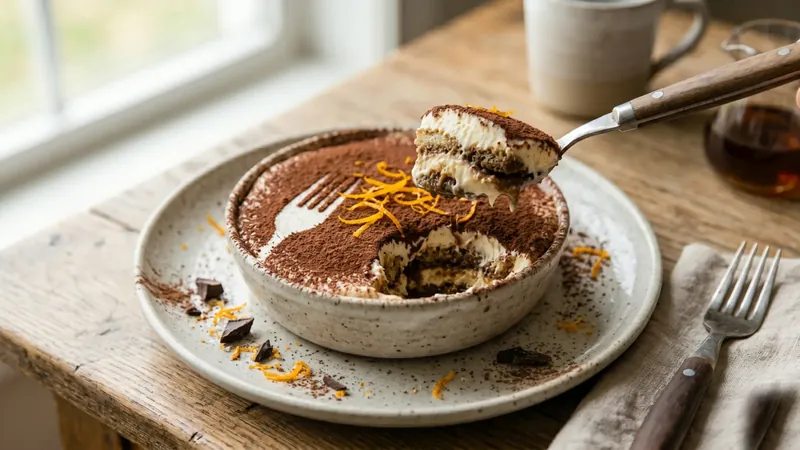
Tiramisu’s construction — savoiardi (ladyfinger biscuits) briefly soaked in strong coffee, layered with a whipped mixture of mascarpone, eggs and sugar, and finished with a dusting of cocoa powder — made it unusually easy to standardise and reproduce outside Italy compared to more technique-dependent Italian desserts. No oven is required for the classic version, the ingredient list is short, and the assembly translates well to home kitchens, all of which helped it become one of the most widely replicated Italian desserts internationally, appearing in countless flavoured variations from restaurants and home bakers who have never visited the Veneto. Its short ingredient list has also made it a frequent target for mass-market reformulation — supermarket tiramisu, tiramisu-flavoured yoghurt and even tiramisu-flavoured spirits now trade on the dessert’s name recognition far beyond anything resembling the original restaurant recipe, a commercial afterlife few Italian desserts of any age have matched at comparable speed.
How It’s Celebrated
National Tiramisu Day observance is led mainly by restaurants, bakeries and home cooks rather than any formal institution, with Italian restaurants worldwide frequently running the dessert as a featured special. In Treviso itself, the dessert’s home city has hosted dedicated festivals celebrating tiramisu specifically, drawing crowds to sample variations and, at times, attempt record-breaking versions of the dish assembled at enormous scale. Food media outlets commonly mark the date with recipe features, often including the classic Le Beccherie-style version alongside contemporary reinterpretations.
World Variations / Cultural Context
Tiramisu has proven unusually adaptable to flavour substitution while keeping its basic layered structure recognisable: matcha tiramisu is common across parts of Asia, fruit-based versions substitute liqueur-soaked fruit for coffee, and countless bakeries produce tiramisu-flavoured cakes, macarons and even ice cream that borrow the name and flavour profile without the original layered construction at all. Some purists in the Veneto regard these adaptations as a dilution of a specific, relatively recent recipe rather than an ancient dish flexible enough to reinvent, a tension similar to debates around other geographically specific but historically young dishes.
Traditions and Symbols
The trifle-style glass dish, allowing the layers to be seen from the side, has become closely associated with how tiramisu is presented and photographed, even though the original restaurant version was more commonly served from a larger tray and portioned individually. Cocoa powder dusted over the top in a fine, even layer just before serving is treated as close to non-negotiable by traditionalists, both for flavour contrast and because a bare, undusted top is read as a sign of an unfinished or careless dessert.
Getting the Layers Right
Home cooks attempting tiramisu run into the same handful of technical pitfalls repeatedly, which is part of why so many recipe writers treat the dish as deceptively simple. Over-soaking the savoiardi in coffee turns the base soggy and collapses the layers into mush rather than the distinct strata a good tiramisu should hold; the biscuit should only be dipped for a second or two rather than submerged. Mascarpone is prone to splitting if beaten too aggressively or combined with a custard base that is still warm, since its high fat content behaves differently from the cream cheese many non-Italian bakers substitute for convenience. And the classic recipe’s reliance on raw egg — whipped egg yolks for richness, whipped whites folded in for lightness — means temperature control and fresh, good-quality eggs matter more here than in desserts that bake the eggs into safety. Refrigerating the assembled dessert for at least several hours, ideally overnight, before serving is treated as essential rather than optional: the flavours and textures only fully integrate once the layers have had time to settle against each other.
Fun Facts
Mascarpone, tiramisu’s defining ingredient, has its own murky and much older origin story, with some accounts tracing it to sixteenth- or seventeenth-century Lombardy, meaning the cheese predates the dessert built around it by roughly 400 years. Raw egg is traditional in the classic Italian recipe, whipped into the mascarpone mixture uncooked, which has led many recipes outside Italy to substitute a cooked custard base or pasteurised egg products over food-safety concerns rarely raised in the original Veneto kitchens. Ada Campeol, the restaurant owner credited alongside her pastry chef with the dish’s creation, has said in interviews that the dessert was initially intended partly as a nutritious pick-me-up for new mothers, tying the “cheer me up” name to a specific, practical original purpose rather than pure marketing. And tiramisu’s relative youth as a “classic” has not stopped some regions from pursuing formal protected-origin status for it, following the path Italy has used for older foods like Parmigiano-Reggiano and prosciutto di Parma. Some etymological accounts of the name push its restorative meaning further, noting that in parts of the Veneto the phrase “tirami su” was already used colloquially to mean something closer to “buck me up,” well before it was borrowed for the dessert.
Beyond the Restaurant Version
Chefs and food writers have spent decades pushing tiramisu past its original restaurant format without abandoning its core identity, and the results say something about how flexible a genuinely well-balanced flavour combination can be. Frozen tiramisu semifreddo swaps the soft, spoonable texture for something closer to ice cream cake while keeping the coffee-mascarpone-cocoa profile intact. Tiramisu cheesecake, tiramisu tart and even tiramisu-flavoured tiramisu-adjacent cocktails built around espresso and cream liqueur all borrow the same three-note structure — bitter coffee, rich dairy, dark cocoa — that made the original work in the first place. Whether any of these count as tiramisu at all, or simply as desserts trading on its name, is exactly the kind of argument Veneto traditionalists and international pastry chefs are unlikely to ever fully settle.
A Closing Reflection
Tiramisu’s disputed but recent birth makes it an unusual case among the world’s iconic desserts: most acquire their legends after centuries of obscurity, while this one arrived already documented, contested and marketed within living memory. That closeness to its own origin story links it more to other food days built on a traceable modern invention than to ancient harvest customs — a contrast visible against older dessert traditions marked on US National Dessert Day and the espresso culture it depends on, explored on Italian National Espresso Day, as well as the cocoa that finishes it, marked separately on National Cocoa Day. Few dishes get to have their invention argued over by people who might have actually been in the kitchen when it happened.
Cook for it
Read next


